
Welcome this post on the use of flexible grouping to support adaptive teaching. This is part of a wider set of article and resources aimed at improving our ability to achieve inclusive excellence and high expectation within our classrooms.
What?
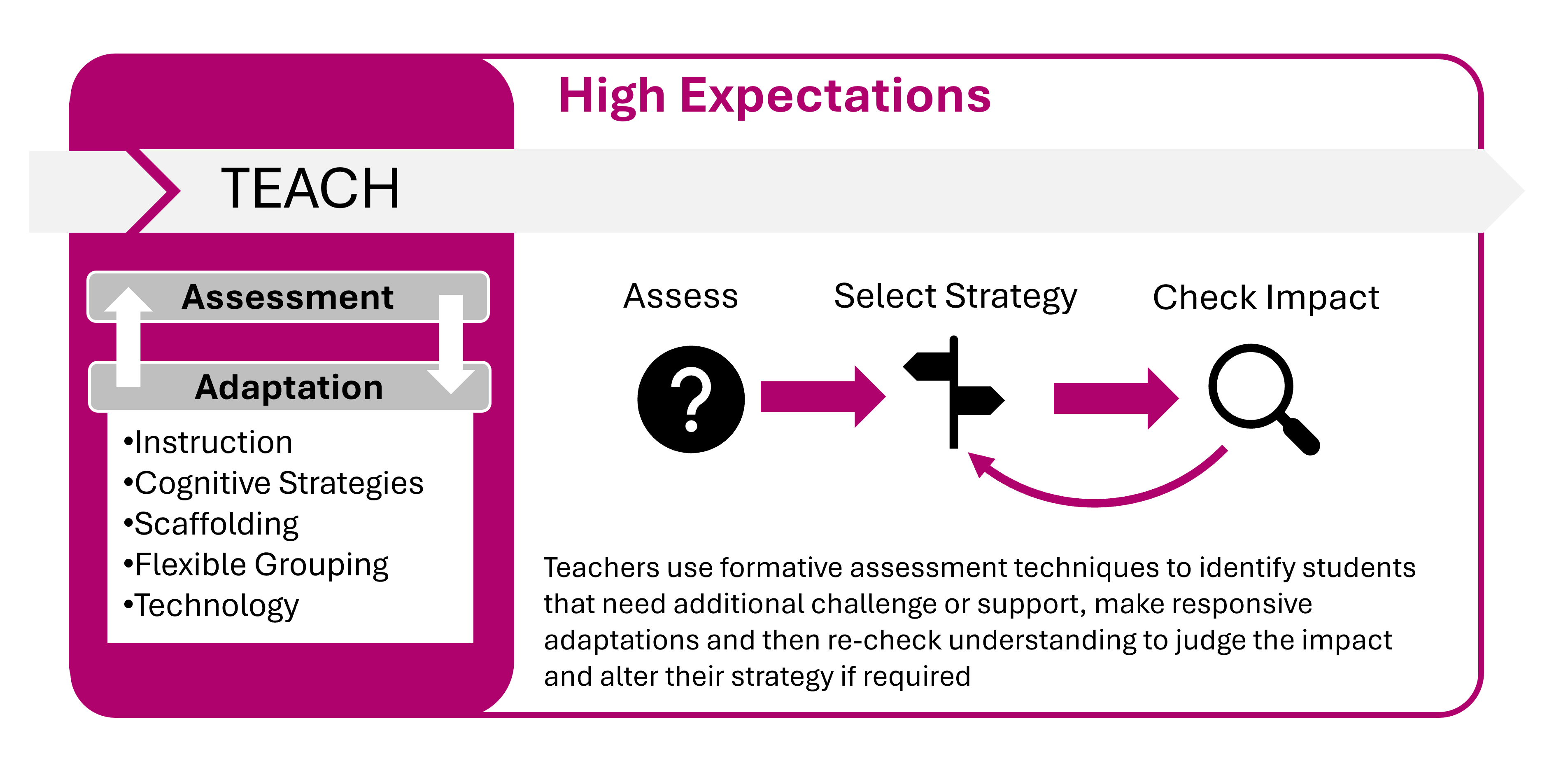
Flexible grouping involves allocating pupils to groups temporarily, based on their individual needs. Critically, such groups are formed for an explicit purpose following formative assessment and disbanded when that purpose is met.
Why?
Flexible Grouping acts as a powerful enabler of adaptive teaching in several ways:
How?
Needs-Based Grouping
Teachers allocate pupils to groups based on a shared need to address a misconception, acquire a skill, or practice. The need is typically identified from previous learning and the groups and tasks planed before the lesson.
Collaborative Grouping
Pupils with a range of attainment levels can be grouped together to engage in peer problem solving. This approach is useful for activities that require collaboration and for developing leadership skills.
In-the-Moment Grouping
During a lesson, a teacher may form a temporary group of pupils who require immediate support. With this temporary group, the teacher can reteach content, clarify vocabulary, or address a misconception.
Peer-Support Grouping
This strategy involves creating flexible groups where students with a particular strength are combined with those for whom the same area requires development and a peer support relationship can be formed.
Social Development Grouping
Grouping can be used to facilitate positive peer interactions, enhance academic and social skills and boost motivation and engagement.
Barriers & Solutions
Below are a series of common challenges that staff may face and some strategies for overcoming them
| Common Barrier | Possible Solution |
|---|---|
| Fixed Grouping/Streaming - Research indicates that permanent sets or streams, where pupils are grouped by overall attainment, can be detrimental to low-attaining pupils and may have long-term negative effects on engagement | Allocate groups flexibly based on shared, specific needs for an explicit purpose. The groups must be temporary and disbanded once the learning goal is met |
| Lack of Assessment Data - Successful flexible grouping demands that teachers know their pupils well and constantly use up-to-date formative assessment data | Embed formative assessment as an ongoing practice to maintain an accurate understanding of who needs what and when. This continuous assessment informs immediate or pre-emptive actions. |
| Lack of Group Monitoring - Without explicit monitoring, groups may fail to provide productive learning opportunities, especially in heterogeneous groups | Teachers must monitor peer interactions actively, provide positive and corrective feedback, and use procedures to hold pupils accountable for their work |
| Lower Quality Instruction - When pupils are separated into groups for targeted support, they may receive a lower quality of teaching from less-qualified staff. | Ensure that the classroom teacher retains accountability for the learning of pupils in groups and any support staff are well prepared and sufficiently resourced |
Measuring Success
Below are a series of indicators that we can use to judge whether the flexible grouping strategy has been successful:
Further Study
Below are a series of links to additional reading, research and CLF bright spots