
The following post explores the possible misconception that we should be recruiting and developing leaders who can do everything. The post looks at some theories surrounding this idea and how the answer may be in the protection of spiky leaders and the creation of rounded teams.
One potential misconception for both organisations and individuals is the idea of a complete leader, one that has a full deck of skills and abilities.
The concept of ‘great man’ leadership where a single hero swoops in to save an organisation or team has thankfully seen its day (Murphy, 2001) and has positively led to an emerging body of research interested in ‘distributed leadership’ as a powerful engine for change (Harris, 2003).
Leadership competency models have not helped the situation by providing a set of skills or attributes that leaders should possess or develop and by promoting a message of leadership roundness. As previously mentioned, it is often the case that leadership professional development is centered around the development of deficits rather than the enhancement of established strengths.
Balancing this pursuit of a ‘Full Deck’ is the concept of Spiky leaders or leadership. A study by Egon Zehnder and McKinsey & Company in 2011 found that spiky leaders who excel in at least a few capabilities but are average or even under performers in others have the greatest impact on organisational growth. In the study they highlighted the need for organisations to:
As the image opposite highlights, most leaders have varying levels of mastery within the different skills or capabilities that they or their organisation promote.
This variability creates a spikiness in visual representations of leadership assessment and typically directs professional development towards the smallest spikes.
Rather than seeing this as an issue to solve, maybe we should embrace the reality that expertise does not work in this way. The degree of focus and volume of deliberate practice required for mastery makes it unlikely to achieve across broad skills sets.
As Zehnder and McKinsey suggested, maybe we should recruit and develop spiky leaders who excel in specific areas and accept their weaknesses in others?
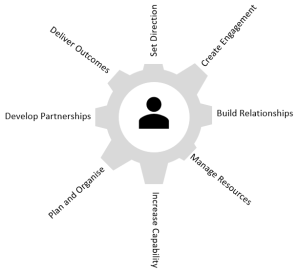
An important consideration when seeking spiky leaders is the depth to which their differences exist.
The variety of organisational demands and dynamic challenges make it seem wise to strive for a leadership team that contains a variety of expertise but has some elements that remain stable.
Successful leadership teams share a set of core values (internal beliefs and opinions) and principles (external rules and laws) which guide behaviour and shape culture.
Variation between these would not be productive and thus spikiness must be contained to a leader’s expertise (knowledge and skill).

As previously highlighted, the notion of a single hero leader has lost traction and organisations are now rightly looking to distribute leadership and to develop a collective efficacy.
As the image to the right indicates, organisations will typically have a range of spiky leaders with different levels of expertise
The goal is to bring together a set of leaders with extreme levels of expertise in specific areas which complement each other to form a more complete knowledge and skill base.
‘We are looking for rounded teams not rounded leaders‘
The challenge for organisations is three fold:
Ideally, when leadership assessment charts are laid over each other, weaknesses in one area are compensated by the strengths of another leader. Common areas of weakness should be a priority for the recruitment of new leaders and the professional development of existing ones.


A key priority for senior leaders within organisations should be the the pursuit of excellence and this can be achieved through effective recruitment and professional development.
The recruitment of new leaders should focus on expertise diversity and seek to add complementary knowledge and skills to the team. Values should be shared as should the acceptance of the established principles but at an expertise level, more of the same if not the goal.
Professional development for leaders should not strive for ’roundness’ or the acquisition of all capabilities at the expense of excellence. Clearly where knowledge and skills are below expected levels then leaders must improve but the enhancement of key strengths should be the priority.
References
Harris, A. (2003) Distributed Leadership in Schools: Leading or misleading? Management in Education. 16. pp. 10-13.
Murphy, J. (2001) Re-culturing the profession of educational leadership: New blueprints. Educational Administration Quarterly. 38 (2), pp. 176-191
The Conference Board. (2006) Are they really ready to work? Employers’ perspectives on the basic knowledge and applied skills of new entrants to the 21st century. New York, NY: U.S. workforce.