
Welcome this post on the use of cognitive and metacognitive strategies to support adaptive teaching. This is part of a wider set of article and resources aimed at improving our ability to achieve inclusive excellence and high expectation within our classrooms.
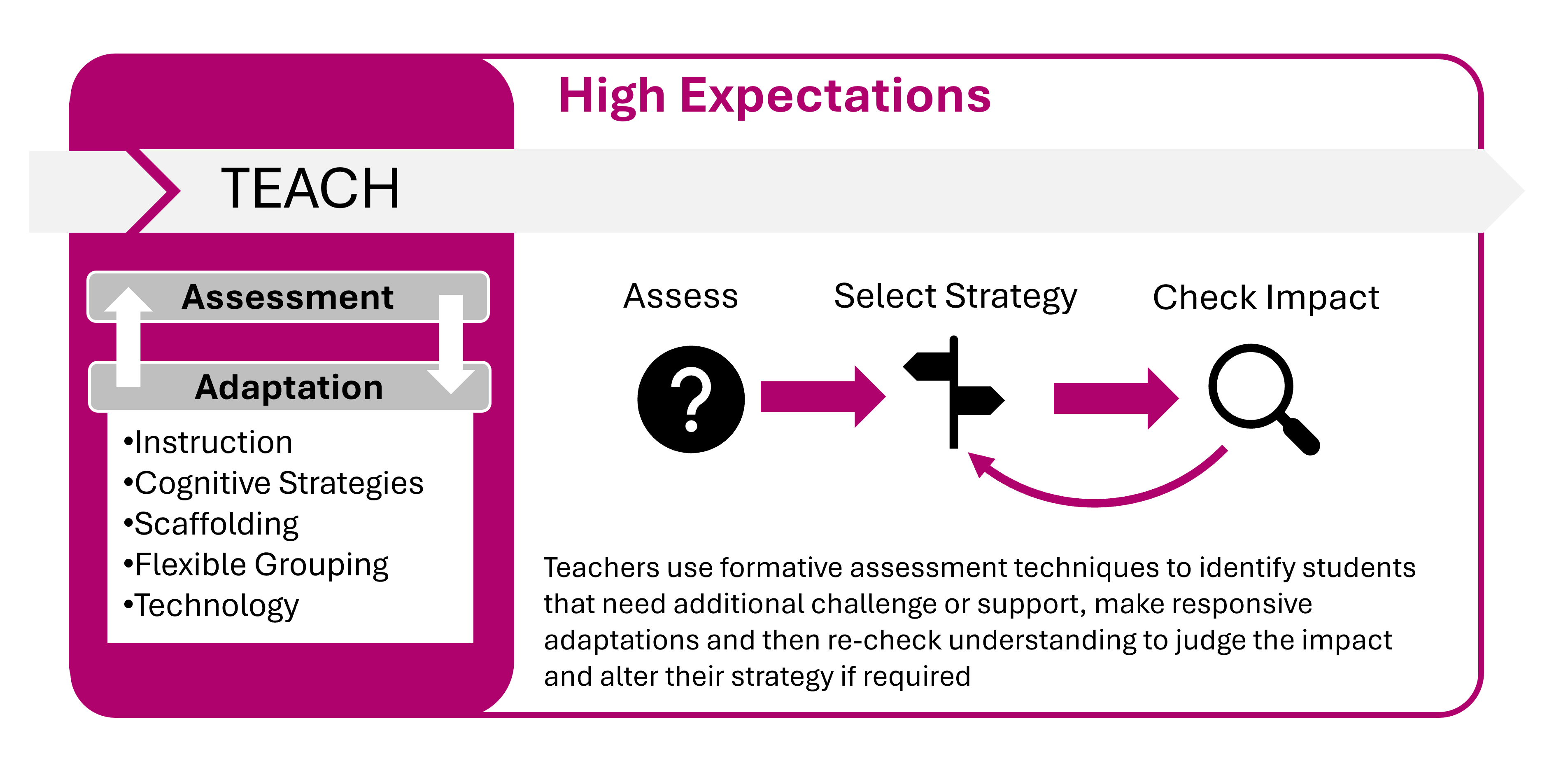
What?
Cognitive strategies refer to the specific techniques teachers use that explicitly support pupils to learn and retain information. They represent the mental processes involved in knowing, understanding, and learning. Cognitive strategies form a fundamental pillar of this adaptive approach, as they are the very tools pupils use for processing and securing knowledge. Alongside metacognitive strategies (thinking about thinking), cognitive strategies are considered a core element of high-quality teaching for all pupils, particularly those with Special Educational Needs and Disabilities (SEND)
Why?
Cognitive and Metacognitive strategies enhance learning by:
1. Building independent skills: The explicit use and teaching of cognitive strategies builds the skill set of pupils so they can learn independently and think metacognitively. (you can't select the right strategy, if you don't know any).
2. Improving long-term memory storage and recall: Elaborating, organising and visualising help strengthen long term memory by making deep connections, helping to structure knowledge and providing mental hooks for effective retrieval.
3. Enabling pupils to Plan, Monitor and Evaluate learning: Metacognitive self-talk enables pupils to successfully prepare for tasks and questions, to monitor the effectiveness of their learning during tasks and to evaluate their success afterwards and action plan for the future
How?
Rehearsal and Repetition
By strengthening knowledge in the long-term memory we can improve recall and free up the working memory when learning new knowledge. Examples include choral response, rote repetition spaced & retrieval practice.
Elaboration
We can enhance learning and strengthen long-term memory by making deep connections between new and existing knowledge. Examples include Interrogative questioning, self-explanation, concrete examples, comparing, contrasting, analogies
Organisation
Visual representations help structure and organise knowledge, concepts, and ideas making abstract learning more concrete. Examples include Venn diagrams, Frayer models, flow charts and graphic & knowledge organisers
Visualisation
Creating mental hooks that connect knowledge can improve recall and make it easier to retrieve abstract information. Examples include acrostics, acronyms, guided imagery, memory palace and the keyword memory method
Metacognitive Talk
Getting pupils to engage in purposeful self-talk, peer discussion and teacher Q&A linked the planning, monitoring and evaluation of learning can boost understanding and self-regulation.
Barriers & Solutions
Below are a series of common challenges that staff may face and some strategies for overcoming them
| Barrier | Possible Solution |
| Cognitive Overload: Giving too much information or expecting new strategies to be applied simultaneously with challenging tasks can overburden the pupil's working memory | Chunking and External Aids: Break down activities into simpler steps. Encourage the use of diagrams, notes, or external aids to reduce load on working memory. |
| Teaching Discretely - Teaching cognitive strategies in generic "learning to learn" or "thinking skills" lessons, separate from content, is ineffective | Embed in Curriculum: Strategies are best taught when applied in relation to specific curriculum content and tasks. Cognitive strategies require a strong grounding in subject knowledge to be effective. |
| Implicit Expert Knowledge - Teachers, as experts, often use cognitive processes unconsciously, failing to make them explicit for novice learners. | Model Explicitly: Teachers must consciously model their thinking aloud (e.g., in a "think aloud") to reveal implicit skills. Use a gradual release model (like the seven-step model) to move pupils toward independence. |
| Inaccurate Judgments of Learning - Pupils may falsely believe they are learning effectively when using less successful strategies (e.g., "cramming") | Explicit Reflection and Monitoring: Explicitly teach the benefits of powerful strategies (like spaced practice). Use self-testing and structured reflection (Evaluation phase) to help pupils accurately judge their learning and adjust future methods. |
Measuring Success
Below are a series of indicators that we can use to judge whether the adaptive strategy has been successful:
Further Study
Below are a series of links to additional reading, research and CLF bright spots