
Much, if not all of an individual's conscious behaviour is a result of their inner voice
The following post explores the impact of our inner voice, often described as self-talk and highlights some surprising insights about how we can use this ongoing narrative to positively influence our lives.
Self-talk has been described as the internal narrative that an individual has about themselves and is thought to be a mix of conscious and unconscious beliefs and biases that we hold about ourselves and the world more generally.
It feels appropriate to first emphasise the power of our inner voice and highlight the significant impact that it has on our day to day lives. Below are a sample of researchers who have linked thoughts, beliefs and self-talk to behaviour. The findings support the view that much if not all of our behaviour is a result of our own beliefs and inner voice.
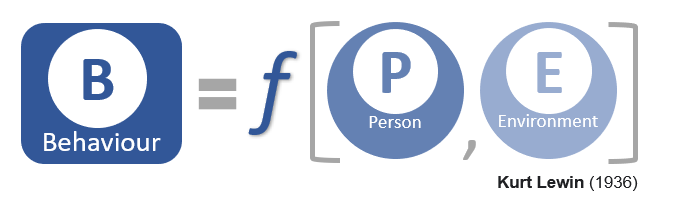
Kurt Lewin first presented the model below as an attempt to create a theory to unite the different branches of psychology. His work on field theory suggested that a person's life space determined their behaviour and the equation positioned behaviour as a function of the person and their environment. Thoughts and self-talk are a key element of a person and therefore a key influence on behaviour.
Albert Ellis created a psychological model which is now used in cognitive behaviour therapy to support individuals to reflect on the links between stimulus and response. The model suggests that an individuals' beliefs about an event will in part determine their response and thus the consequences. Self-talk therefore has the power to affect behavior and the consequences of events.

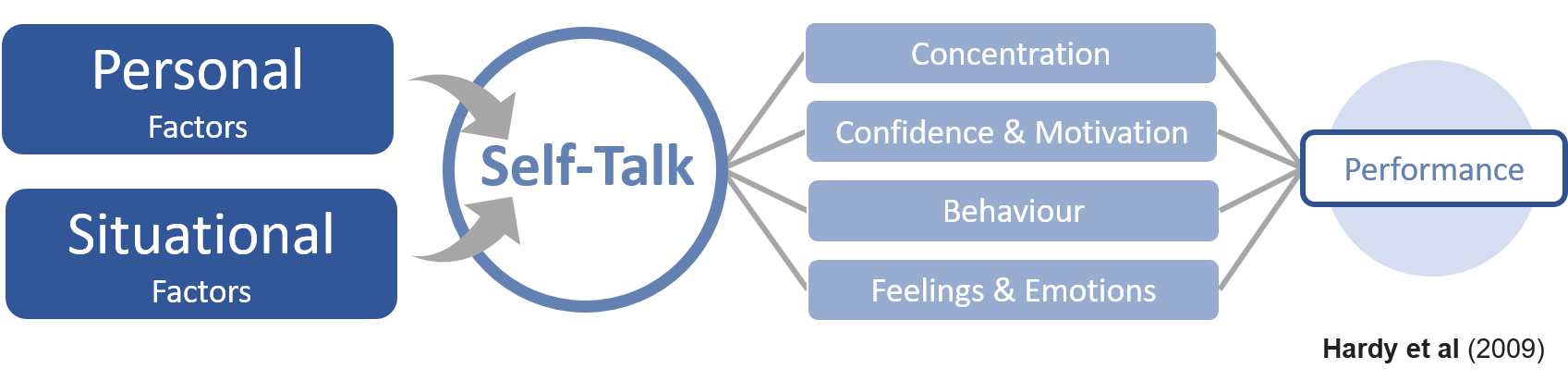
James Hardy, Emily Oliver and David Todd created the following model to describe the impact that self-talk can have on sports performance. As with the previous models, there is an acknowledgement that self-talk is influenced by the person and their environment and this in turn has an internal impact which then subsequently affects performance. The model highlights how self-talk can affect a variety of internal elements including concentration, confidence, behaviour and emotions and these in turn impact on our effectiveness.
The literature and research on self-talk highlights a series of categories and continuums that are used to describe different types of internal dialogue and the following sections explore these in more detail.
One of the most common ways of describing an individual's self-talk is as either positive and negative.
As the name suggests, this type of self-talk takes the form of positive messages and thoughts.
Researchers have explored the impact of positive self-talk on a range of different areas including anxiety, learning, sports performance and eating disorders. Todd, Oliver, and Harvey (2011) completed a literature review and unanimously found that positive self-talk interventions were effective in mediating cognitive and behavioral change.
Studies have shown positive self-talk to have the following benefits:
Some examples of positive self-talk include:
Sadly, a lot of self-talk is negative and many of our internal messages and thoughts come from preconceived beliefs about our capabilities or qualities. Jantz, (2016) suggested that the prevalence of negative self-talk may be due to the tendency for individuals to remember negative experiences more than positive ones.
Some common examples of negative self-talk include:
In order to identify the impact of negative self-talk we can look to the reverse of the aforementioned benefits of positive messaging which show how it can have a detrimental impact on our mental and physical health.
So the message is clear that we should be trying to develop a more positive inner voice and participate in more positive self-talk. But what constitutes effective positive self-talk?
Psychologists and researchers of self-talk also classify it into either declarative or interrogative and the following section explores this is more detail.
Declarative means 'to make a declaration' and so this type of self-talk presents itself as statements of perceived truth. These declarations are typically either affirmative or evaluative.
Affirmative statements often come before or during a task and examples might include "I can complete this task" or "I am doing really well at this" and are used to create or maintain motivation levels.
Evaluative statements often come after a task has been completed and examples might include "I did really well in that" or "I gave my best in that task". These are used to celebrate actions or effort and strengthen confidence for future attempts.
In contrast to declarative affirmations, interrogative statements involve individuals asking themselves questions about their ability. The corresponding examples would be "can I complete this task?" or "am I doing really well at this?"
The grammatical structure of self-talk has become of particular interest to psychologists and developmental coaches as they search for additional levers to support their clients. Individuals in these roles have long used open ended and rhetorical questions to place the emphasis back onto the client and to elicit self-generated ideas and solutions. A research study by Senay, Albarracín and Noguchi (2010) found that interrogative self-talk led to changes in motivation and goal-directed behaviour and suggested that further work is warranted to explore the important but long-overlooked effects of the shape of introspection on behavior.
Interrogative self-talk may produce the following benefits:
Daniel Pink highlights the active nature of interrogative self-talk and the way that it often acts as the start of a more detailed and useful self-talk episode. Questions such as "Can I do this and if so, HOW?" require further thought and can lead to a greater level of preparation and pre-task confidence.
There are clear links between our thoughts, our behaviors and our performance.
Clearly, we should reduce negative self-talk where possible and increase our levels of positive self-talk.
Positive declarative affirmations of self-talk such as "I can do this" are great and play a key part in increasing motivation but there may be an even better alternative.
The power of interrogative self-talk lies in the demands it places on the individual to take further action. Interrogative questions force you to think more deeply by requiring an answer and to creatively plan a course of action.
So the next time you tell yourself you can do something, flip it into a question and extend the self-talk to explore why you feel that way. You may be surprised by the increased motivation and performance.