
In the following post we explore the what, why and how of cognitive biases and the surprising impact that they have on our daily lives.
What is a cognitive bias?
A cognitive bias is a systematic error in thinking that occurs when people are processing and interpreting information in the world around them and affects the decisions and judgments that they make. These biases act as individual filters through which individuals view and experience the world.
When do they occur?
Every cognitive bias is there for a reason — primarily to save our brains time or energy.
Buster Benson in his excellent blog post outlines four situations where cognitive biases typically occur:
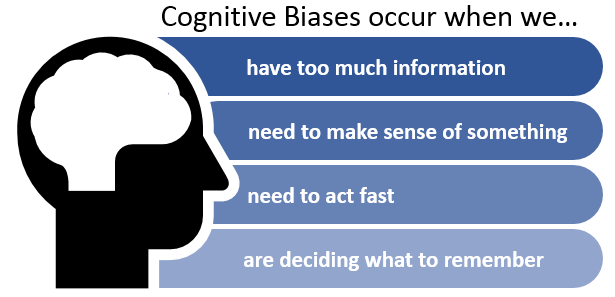
When there is too much information
In order to avoid drowning in information overload, our brains need to filter large amounts of information and quickly and effortlessly, decide which few things are actually important.
In these situations we typically:
When we need to make sense of something
In order to construct meaning out of the bits and pieces of information that come to our attention, we need to fill in the gaps, and map it all to our existing mental models.
In these situations we typically:
When we need to act fast
In order to act fast, our brains need to make split-second decisions that could impact our chances for survival, security, or success and also feel confident that we can make things happen.
In these situations we typically:
When we are deciding what to remember
And in order to keep doing all of this as efficiently as possible, our brains need to remember the most important and useful bits of new information and inform the other systems so they can adapt and improve over time.
In these situations we typically:
What are the different biases?
There are a huge variety of different cognitive biases with varying degrees of occurrence, impact and research base.
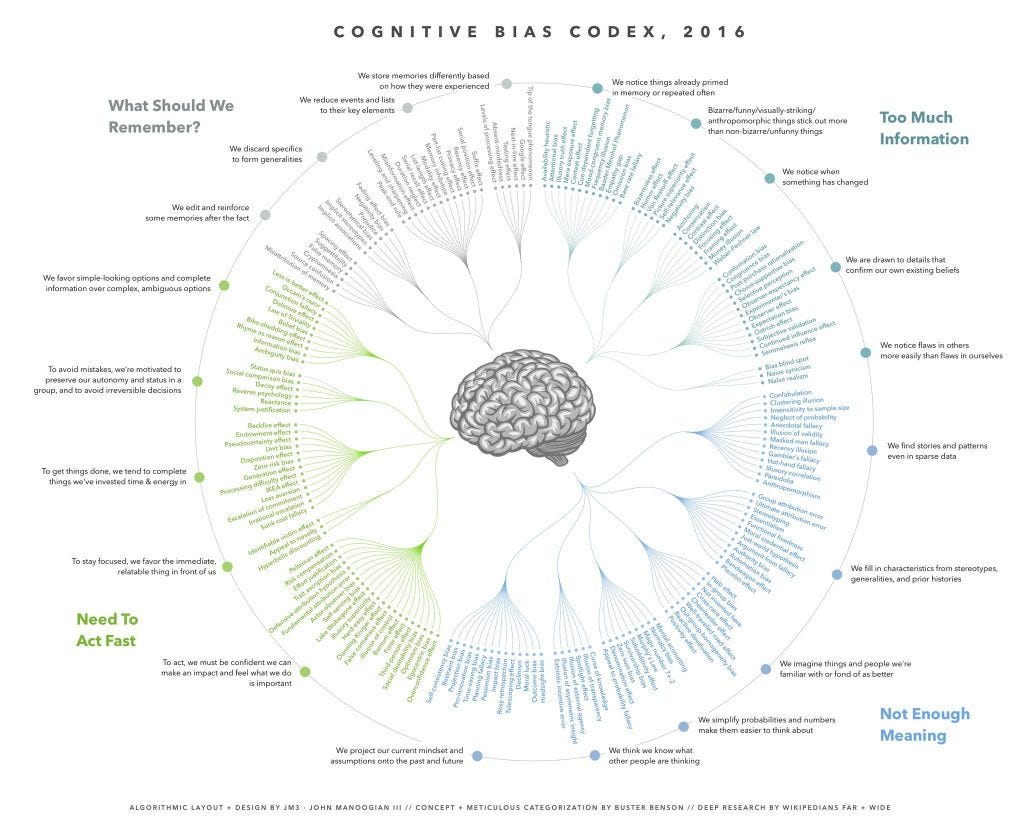
The incredible diagram to the right by John Manoogian attempts to organise the wide range of cognitive biases into categories focused on the challenges we face when processing information.
You can view the full size image HERE or visit the interactive image HERE
The following section will explore some of the most common Biases.
Common Cognitive Biases
Anchoring Bias
This is the tendency to rely too heavily on the very first piece of information you learn. The danger is that we interpret newer information from the reference point of our anchor, instead of seeing it objectively.
Attentional Bias
This is the tendency to pay attention to some things while simultaneously ignoring others. The danger is that our attention is directed towards the wrong information and thus we don't have what we need to make a good decision.
Availability Bias
This is the tendency to place greater value on information that comes to your mind quickly. The danger is that we jump to quick decisions without exploring the evidence or alternatives appropriately.
Confirmation Bias
This is the tendency to favour information that conforms to your existing beliefs and discount evidence that does not. The danger is that we drive our personal agendas and trust information because of familiarity instead of rationality.
Hindsight Bias
This is the tendency to perceive past events as having been more predictable than they actually were. The danger is that we become overconfident in our ability to predict the future and make good decisions.
Negativity Bias
This is the tendency to pay more attention and be affected more by negative events and emotions than positive ones even when they are present in equal measure. The danger is that we gain an inaccurate view of situations or lose a sense of perspective.
Omission Bias
This is the tendency to favour an act of omission (inaction) over one of commission (action). The danger is that we unconsciously seek to maintain the status quo and therefore slow or halt progress.
Projection Bias
This is the tendency to project our beliefs, values, and behaviours onto others or into the future. The danger is that we do not seek alternative views and that we underestimate the need for change.
Sunk-Cost Bias
This is the tendency to continue a behaviour or endeavour as a result of previously invested resources (time, money or effort). The danger is that we fail to stop or change ineffective actions in time to improve their impact.
Social Desirability Bias
This is the tendency to answer questions or behave in a manner that will be viewed favourably by others. The danger is that we over-report the good and under report the bad. There is also a danger that views and ideas are not shared because they conflict with the norm.
What can we do about them?
We can’t avoid our biases. The best we can do is maintain an honest dialogue with our blind spots and commit to identifying and repairing inadvertent damage caused by them as efficiently as possible.
Buster Benson, 2019
Strategies for dealing with cognitive biases typically come from the literature on either Debiasing or Cognitive Bias mitigation but both are clear about the mixed results that any explicit strategies can have on biases that are largely unconscious. The first step in dealing with cognitive bias is acknowledging the possible presence of a bias blind spot which describes how we see biases in others must more readily than we see in ourselves.
Once that has been done there is a range of possible ways forward:
Reflective Questions?